[Este post está orientado a estudiantes que comienzan una carrera universitaria en ciencias, no necesariamente geología]
El Mar Mediterráneo es lo que resta en la actualidad del antiguo Océano de Tethys, que quedó atrapado entre las placas tectónicas de África y Eurasia durante su lenta aproximación en los últimos 65 millones de años. A causa de esta aproximación,la corteza terrestre oceánica que alojaba al Océano de Tethys fue obligada a hundirse (a subducir) en el manto terrestre, bajo Eurasia, tras lo cual se produjo la colisión entre ambos continentes, formando los Pirineos, los Alpes y las Montañas de Zagros (orogenia Alpina). Fue así como quedaron desconectados el actual Mar Mediterráneo y el Océano Índico hace unos 15 millones de años. Sólo en el Mediterráneo Oriental quedan restos de aquella corteza de Tethys que aún no han subducido y que de hecho constituyen la corteza oceánica más antigua preservada en el planeta: unos 270 millones de años de edad. Puedes descargar este espectacular KML para Google Earth y visualizar la edad de formación de la corteza terrestre.
Fig. 1. Movimiento de las placas tectónicas deducido principalmente a partir del campo magnético grabado en las rocas (técnica conocida como paleomagnetismo) y de la geología y paleontología observadas en superficie.
Fig. 2. Movimiento de rotación de África respecto a Eurasia en los últimos 190 Millones de años. A partir de medidas de paleomagnetismo en rocas. Vía MantlePlumes.org
Es sorprendente encontrar la corteza oceánica más antigua del planeta en el Mediterráneo, pues el acercamiento entre Europa y África continúa hoy a un ritmo geológicamente rápido, de unos 4 milímetros por año en la región más occidental (entre España y Marruecos), y a velocidades aún mayores y con mayor actividad sísmica en Grecia o Turquía.
Fig. 3. Movimiento relativo de Anatolia y el este del Mediterráneo respecto a Eurasia, obtenido a partir de medidas de GPS de alta precisión. La longitud de las flechas indica la velocidadactual debido a la tectónica medida en una estación de GPS. Las mayores corresponden a 4 cm/año.
Fig. 4. Modelo de la velocidad tectónica en el Mediterráneo (flechas
relativas a Eurasia) y de las tasas de deformación que implican.
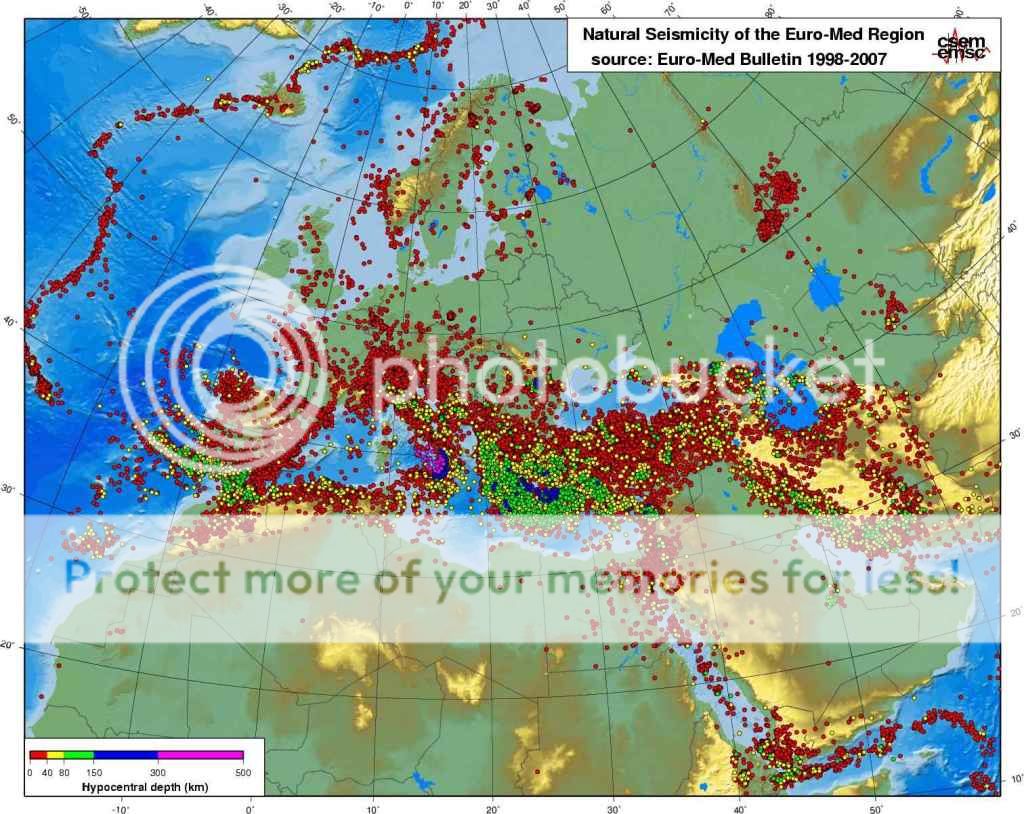
Pero el Mar Mediterráneo ha tenido una evolución tectónica más compleja que la simple subducción de África bajo Eurasia, como reflejan la heterogénea distribución de los terremotos (Fig. 5) y los varios dominios o subplacas cuyos movimientos tectónicos responden de manera poco intuitiva al acercamiento entre los dos continentes (Fig. 6b).
Fig. 5. Distribución de terremotos y su profundidad en el área mediterránea.
Como consecuencia de la geometría heredada de ambos continentes, se han formado varias zonas de subducción diferenciadas (Fig. 6b) en las que la corteza oceánica de Tethys es cabalgada por los márgenes del sur de Europa antes de sumergirse en el manto terrestre. Un ejemplo es la subducción que se produce en el Arco de Calabria (Sicilia y sur de Italia), donde la placa Africana subduce bajo el Mar Tirreno, dando origen a una importante actividad sísmica y volcánica (Etna, Stromboli, etc, Fig. 6c).
Fig. 6a. Esquema del proceso de subducción
de las placas tectónicas oceánicas.
Fig. 6c. Hundimiento y retroceso del slab
(de la porción de placa tectónica subducida)
de Tethys dando lugar a la formación por
extensión de la corteza del Mar Mediterráneo
(Mar Tirreno en la imagen). África a la derecha; Europa a la Izda. De Faccenna et al., GJI, 2001)
Fig. 6b. Mapa tectónico simplificado del Mediterráneo actual, mostrando la edad de formación de la nueva corteza oceánica (azul, de hasta 25 millones de años) tras la subducción del Tethys en la parte occidental. Las zonas mucho más antiguas de corteza oceánica en la zona oriental (morado) corresponden a la placa del antiguo océano de Tethys. Las líneas dentadas rojas indican las fosas donde esa placa se adentra en el manto (subduce) bajo Europa.
Para entender la formación del Mediterráneo es clave comprender un proceso llamado extensión de tras-arco (back-arc extension), que es el estiramiento o extensión de la corteza terrestre que ocurre detrás de una zona de subducción, encima del slab subducido (a la izda. en el corte de la Fig. 6c). Debido a la mayor densidad de la placa de Tethys, ésta se hundió en el manto succionando y estirando la placa bajo la cual subducía (Europa). A consecuencia de esa dinámica (Fig. 7) se separaron del continente europeo las islas de Córcega, Cerdeña y Baleares.Otro ejemplo más lejano del mismo proceso es la separación que actualmente se produce entre Japón y Asia, debida a la subducción de la placa Pacífica bajo la fosa donde se originó el terremoto de Sendai.
Fig. 7. Izda.: la extensión de tras-arco es un estiramiento de la corteza que se produce encima de los slabs subducidos. Vídeo: Simulación de la extensión de tras-arco (back-arc extension) debida al hundimiento y la retirada de una placa tectónica (slab retreat orslab rollback), modelo de Moresi y coautores. Si el lado izquierdo fuera África y el derecho Europa (al revés en el esquema de la izda.), entonces la extensión que se produce en el centro correspondería al Mediterráneo.
Fig. 8. Reconstrucción de la retirada del slab (slab retreat) que da lugar a la extensión del Mar Tirreno y del Golfo de Valencia, separando las islas Baleares de la Península Ibérica, hace unos 25 millones de años. Las líneas discontinuas indican la posición de la subducción hace 30 y 16 millones de años. Las flechas negras indican también el mismo proceso ocurrido en el arco helénico (Grecia) y en la Cuenca Panónica (Hungría/Rumanía).
En resumen: hoy el Mediterráneo occidental ocupa una enorme cuenca extensiva de tras-arco desgarrada tras la subducción de la corteza oceánica de Tethys bajo el continente europeo y la posterior colisión continental entre África y Eurasia. Esta es al menos la visión más generalizada hoy entre los geólogos.
Let me tell a story about serendipity in research, a story that involves abrupt changes in the Earth's landscape and a 5-million-year-old flood of unprecedented scale.
Classical authors such as Aristotle, Galileo, or Leonardo da Vinci, used to describe the birth of the Mediterranean Sea as an enormous flood through the Strait of Gibraltar that filled a desiccated basin. These stories trace back to the oldest known encyclopedia: Plinius' Historia Naturalis (1st century AD). In its 3rd volume, Plinius the Elder recounted a legend from southern Hispania that attributed the formation of the Strait of Gibraltar to Hercules, the god who "allowed the entrance of the ocean where it was before excluded". The Atlantic Ocean flooding a desertic Mediterranean Sea at epic scales. Amazingly enough, the geophysical and geological research carried out in the last decades seems to suggest that this ancient vision may be quite appropriate.
Since the identification of vast salt strata throughout the Mediterranean by Austrian naturalist Karl Mayer (late nineteenth century) we know that the marine connections between this sea and the Atlantic Ocean became small by the end of the Miocene, during a period known as the Messinian age. Modern chronostratigraphy has dated this at 6 to 5.3 million years ago, around the time when our earliest hominin ancestors started walking on two legs in Central Africa. As a result, the Mediterranean became a huge salt pan that accumulated about 10% of the salt dissolved in the world's oceans, during the so-called Messinian salinity crisis. The ongoing tectonic uplift of the Gibraltar Arc region finally emerged the last Atlantic seaway and isolated completely the Mediterranean from the ocean, about 5.6 million years ago. The Mediterranean then became largely evaporated as a result of the dry climate of its watershed. Finally, about 5.3 million years ago the Mediterranean was refilled from the Atlantic through the Strait of Gibraltar. The indications that this occurred geologically very fast (namely, the abrupt change from Miocene to Pliocene sedimentary layers) made this event be known as theZanclean flood.
Simulation of the refill through the strait of Gibraltar
by Steven N. Ward (Univ. California).
Note the water velocity distribution around 1:27.
Geological map of the Gibraltar strait locating the
erosion channel (red) observed with geophysical
methods.
The flood along the Gibraltar threshold may have been caused by its subsidence below the Atlantic level, or by faulting, or by erosion (or a combination of these three proposed mechanisms). But beyond the causes for the flood, another key unknown is the abruptness and evolution of the flood itself: From the sharp transition in the sedimentary layer record, it is widely thought (though not unanimously) that the event was very fast. But in geology fast can mean a hundred thousand years. Because little was known about its dynamics, and perhaps because for geologists rapid major events are rare and challenge the principle of uniformitarianism, the flood duration underwent a wide range of estimations from tens to tens of thousands of years.
Before knowing anything about the Messinian Mediterranean, I used to model the evolution of landscape over geological time scales, particularly interested on the role of lakes in controlling the long-term evolution of topography of large continental regions.
Lakes are those water bodies collecting precipitation in local topographic minima (yes, this sounds a bit Sheldon-like). Lakes are usually ephemeral over geologic timescales: Unless there are vertical tectonic motions enlarging the topographic basin, they soon fill up with sediment, overspilling their banks. When the water finds a way out, it incises along the outlet, drawing the lake's level down, and propagating this erosion upstream into the lake. In our landscape evolution models this transition was systematically very fast, but this result was not convincing enough for two reasons: First, lake data to compare with were scarce, and we were in the need of a large case scenario where traces of erosion were more evident. Secondly, our models where not accounting for transitory water flow, but instead it was calculating a steady flow (i.e., the water precipitation equals the water losses through evaporation at each time step of the simulation).
2D simulation of the evolution of a tectonic lake
formed in front of a growing tectonic barrier.
The lake evaporates the water collected from
the left side. When the barrier stops growing,
its erosion leads to a sudden capture of the lake.
Then I accidentally learned about the Messinian salinity crisis, about its impact in the Mediterranean evolution, and about the megaflood hypothesis for its ending. It struck me that the feedback between water flow and incision we envisaged for lakes should be similar during the Zanclean flood, taking the global ocean as a huge lake on the verge of overtopping towards the dry Mediterranean. Combining the formulation of river incision with the proper hydrodynamic equations, we built a simple but robust mathematical formulation for overtopping outburst floods. We used then erosional parameters derived from the study or mountain river incision, and then incorporated a reconstruction for the Mediterranean seafloor geometry. Then we started running virtual floods.
The first results were so surprising that we thought something was probably wrong with the code. Things were happening much faster than in those lake scenarios we were used to. Because in the Zanclean flood the source is virtually infinite, the Mediterranean was filling in only a few years along a large erosion channel excavated across the Strait of Gibraltar, some hundred meters deep. Unfortunately, the results were strongly dependent on a parameter that is badly constrained: the erodibility of rocks. But if that was correct, we should be able to find traces of the flood erosion preserved under the sedimentary layers in the strait.
Dry Mediterranean, by Roger Pibernat.
So we turned towards previously published research, finding two other pieces of evidence: The first was a vintage seismic image showing a cross-section of the sedimentary layers near the strait area (Campillo et al., 1992). It showed a clear channel running west to east from the strait into the Alborán Sea, carved in the pre-Messinian sediments. The channel had previously been thought to be the result of river erosion of the dried-up strait, but there’s no obvious large river that could have produced that erosion. The second piece of evidence came from cores of rock drilled from the strait area as part of the exploration for the Africa-Europe tunnel project that would build a train connection between Spain and Morocco (Blanc, 2002). These cores also showed a channel deeper than 200 m, wider than 3 km, and filled with post-Messinian sediment. Altogether, the documented erosion valley connecting the Eastern Atlantic to the Western Mediterranean is more than 200-kilometre long. If this were a result of fluvial erosion, it would be strange to find erosion on both sides of the present water divide between Atlantic and Mediterranean. Furthermore, rather than a waterfall over the Gibraltar Strait as previously suggested, the seismic data show a huge ramp, several kilometres wide descending rather gradually from the Atlantic to the Mediterranean.
With these data, we turned again to the models. Using the observed erosion depth and width as a constrain, the model estimated now that the flood may have began slowly, taking up to several thousand years before a significant rise in Mediterranean level occurred. But importantly they also show that 90% of the water must have entered in a period shorter than two years, and that at the peak discharge, water poured in at a rate of 100 million cubic meters per second, about a thousand times the largest river on Earth today. If 'harder' erosion parameters were used, then the refill of the Mediterranean would be predicted to be slower, but the calculated erosion at the end of the flood would be insufficient to reproduce the geophysical images. To fit the observations, the flooding channel had to cut down into the bedrock almost half a meter per day, leading to a large inlet flow that would increase the Mediterranean sea level by more than 10 meters per day.
The technique does not allow constraining the speed of the initial stages, nor the mechanisms involved in triggering the flood. This means that the initial trigger may have been a geologically modest event such a large storm, a tsunami, or a partial collapse of the dividing barrier. What the results do ensure is that in order to account for the final size of the erosion channel, 90% of the water must have been rapidly transferred in a period ranging from a few months to two years.
Possible evolution of the flood derived from the model. The lower panel shows the evolution of the seaway depth as it is eroded by the increasing flow of water (black lines, left scale) and the rising Mediterranean level (red lines). From our article in Nature.
If these observations and calculations are independently confirmed, the Zanclean flood would become the largest known flood on Earth's history. The Zanclean flood involved an order of magnitude more water flow than the megafloods that we know took place during the last deglaciation (e.g., the Missoula floods or the Bonneville flood).
The implications of such a rapid flooding are inevitably big, as a large number of multidisciplinary studies have documented: Global flora and fauna had to adapt to the new
environmental conditions rapidly. Marine species colonized a huge new realm rapidly whereas for land species, particularly in islands, the flooded
Mediterranean became a sudden barrier triggering speciation. Had the land connection remained, it could have facilitated an earlier arrival of early humans in western
Europe. Instead early humans had to take a circuitous route to Western
Europe and didn't arrive until 1.5 million years ago. The Messinian salinity crisis also highlights the importance of seaways in understanding the geological record: straits limit the mix with the global ocean and their size is the key parameter modulating the chemical registry found in sediment. The flood may also have had tectonic implications: The weight of the flooding waters is such that it should have modified the rotation of the Earth, and it should have made the entire Mediterranean region sink by at least one kilometer in the mantle, according to the principle of Isostasy. Also global climate surely must have been impacted by the Messinian salinity crisis and its rapid ending, but so far this is perhaps the most elusive aspect of the crisis, something remarkable since I am not aware of other scenarios in geological history where the climatic response to such a large environmental change can be better tested.
So there are plenty of open questions on the Zanclean Flood that need an answer. More pending Retos Terrícolas.
Video on the Atlantropa Project, showing the collapse of a
projected dam across the Strait of Gibraltar.
[This is related to research of our own group here at CSIC, as published inthis article]
[This post has been published in Mapping Ignorance]
References:
Blanc, P.-L. The opening of the Plio-Quaternary Gibraltar Strait: assessing the size of a cataclysm, Geodin. Acta 15, 303—317 (2002).
Campillo, A., Maldonado, A. & Mauffret, A., Stratigraphic and tectonic evolution of the western Alboran sea: Late Miocene to recent, Geo Mar. Lett., 12, 165– 172 (1992).
Garcia-Castellanos, D., 2006. Long-term evolution of tectonic lakes: Climatic controls on the development of internally drained basins. In: Tectonics, Climate, and Landscape evolution. Eds.: S.D. Willett, N. Hovius, M.T. Brandon & D.M. Fisher. GSA Special Paper 398. 283-294. doi:10.1130/2006.2398(17) [pdf]
Garcia-Castellanos, D., F. Estrada, I. Jiménez-Munt, C. Gorini, M. Fernàndez, J. Vergés, R. De Vicente, 2009. Catastrophic flood of the Mediterranean after the Messinian salinity crisis. Nature 462, 778-781 doi:10.1038/nature08555 [pdf]
Submarine canyons are deep valleys through which sediments eroded from the continents are delivered to the deep ocean, across the continental margins and slopes. One prominent example is the Monterrey Canyon (pdf poster).
They are often regarded as the result of erosion produced by the submarine flow, but this is what we just found in seismic data from the Ebro delta (published last week in Geology, link to abstract):
Doing science consists of formulating refutable hypotheses, this is, new interpretations based on former experience that lead to predictions that can be either confirmed or falsified (by future research).
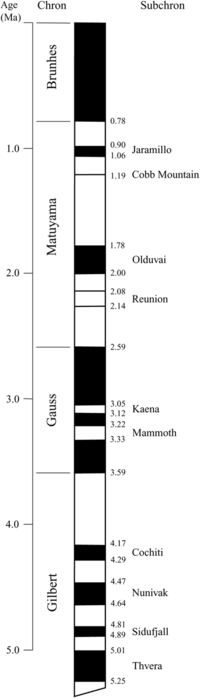
Timing of the last reversals of the Earth's
magnetic field. Time goes from 5 Million years ago (bottom) to present (top).
Periods in black match today's polarity;
periods in white underwent reversed polarity.
Source: Wikimedia Commons. A more complete scale here.
A case history in Earth science is the confirmation of the plate tectonics theory during the 60's. Back in 1912, this theory was just a hypothesis known as continental drift and put forward most remarkably by Alfred Wegener, based on observations of the fossil fauna matching across different continents. Well, in addition to the matching coastlines of continents pointed out by Abraham Ortelius as early as in the... 16th century!
One implication of the continental drift idea was that the oceans laying between continents that drifted away from each other should have gradually spread apart. This is known as the seafloor spreading hypothesis. But how to prove it?
Much earlier than that, the Earth's magnetic field had been studied scientifically since the beginning of the Spanish and Portuguese explorations of the Americas (Alvarez & Leitao, 2010, Geology, The neglected early history of geoscience). By the 17th century, maritime trading was dependent on the accurate mapping of magnetic intensity across the Atlantic Ocean. These studies culminated by the 19th century during the so-called Magnetic Crusade, leading to the realisation that the magnetic poles migrate significantly over historical time periods. And in fact, these rapid changes of the magnetic field soon became one of the theories proposed to explain why the magnetic orientation recorded in rocks depends on their geological age.
North Magnetic pole wander from 1590 to 2015. Click on the pins to see the year. From the GUFM and IGRF models. Via NOAA.
Today we know that historical magnetic changes are normal in periods of stable magnetic polarity, and that although the polarity flips recorded in rocks take just a few thousand years, they occur only over geological time-scales (millions of years).
Computer model based on Glatzmaier & Roberts. Magnetic field lines are in blue when the field points towards the center and yellow when pointing away from it. The rotation axis of the Earth is centered and vertical. The dense clusters of lines are within the Earth's core
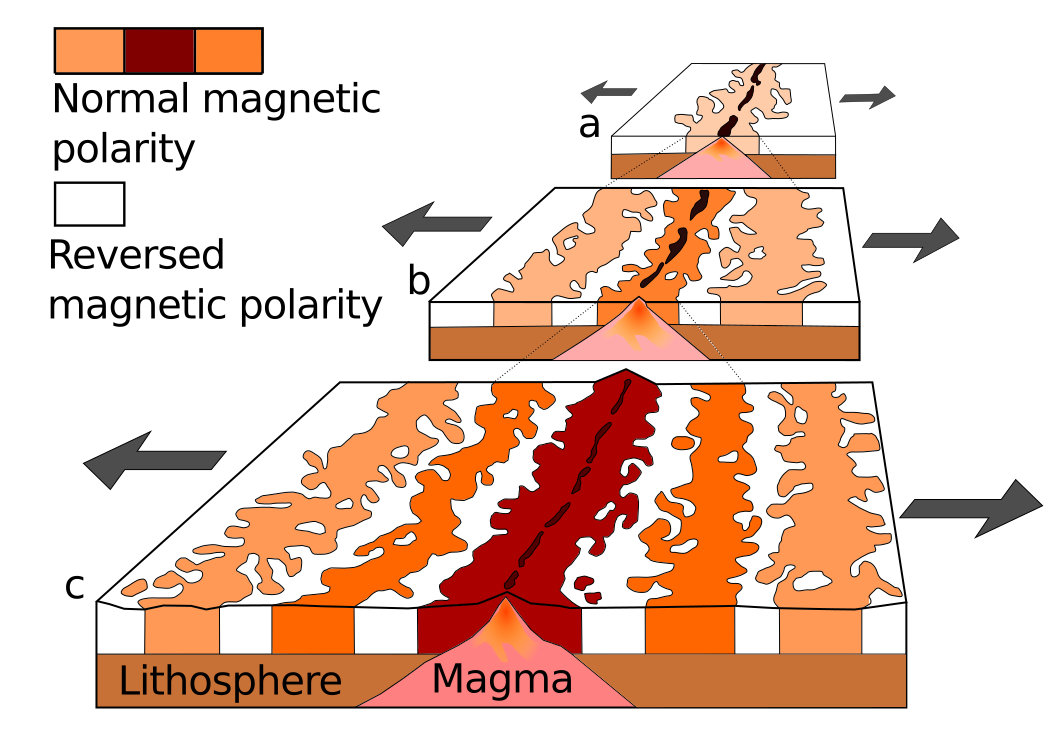
Back in 1957, Marie Tharp found enigmatic alignments in the shape of the seafloor around the center of the Atlantic Ocean, roughly where seismicity was being detected. In 1963, both the geophysicist Frederick J. Vine and the geologist Lawrence W. Morley independently realized that if the seafloor spreading theory was correct, then the rocks surrounding mid-oceanic ridges should show symmetric patterns of magnetization reversals, recording the changes of the Earth's magnetic field in the volcanic rocks at the time when these erupted and cooled down at the mid-ocean ridges. This is
now known as the Vine–Matthews–Morley hypothesis, and became a validation test for the seafloor spreading, and for the plate tectonics theory in general.
Seafloor spreading at a mid-ocean ridge, recording time-changes of geomagnetic field polarity. Source: Wikimedia Commons.
Morley's letters to Nature (February 1963) and to the Journal of Geophysical Research (April 1963) were both rejected, so Vine and his advisor Matthews were first to publish the hypothesis on the same year. The patterns of ancient reversals of the Earth's magnetic field have been found thereafter in hundreds of paleomagnetic surveys, providing a robust validation of their hypothesis. In fact, a vast later work of age calibration of these magnetic reversals allowed for the detailed maps of the age of the oceanic floor that we have nowadays:
Map of the age of the seafloor based on the reversal of the magnetic field
recorded in the oceanic crust during its formation at mid-oceanic ridges.
Red indicates a young seafloor, whereas blue is used for the oldest oceanic crust.
(Source: National Geophysical Data Center)
Magnetic reversals are still today one of the key methods allowing rock dating (don't miss the name for it: magnetochronostratigraphy). But we know very little about the mechanisms responsible for these magnetic field changes. Computer simulations suggest that it is a natural result of feedback forces between the magnetic field and the flow in the Earth's core (see the reference to Glatzmaiers' below), similar to dynamo going tilted by its own magnetic field. It has been recently shown in this article in GRL a correlation between the distribution of tectonic plates and the frequency of magnetic reversals over geological time ("geological intervals characterized by an asymmetrical distribution of the continents with respect to the equator are followed by intervals of high reversal frequency"), suggesting a mechanical coupling between both phenomena. But the specific mechanism behind magnetic reversals and the additional information they may contain about the interior and the past of our planet remain, so far, a challenge (yet another Reto Terrícola!).
Update (2015-09): A Science News article on a recent study on core convection and the magnetic field.
Anyone thinking of the Earth as a static thing? Here is the global magnetic declination in 1492 and today: pic.twitter.com/0WjJiwDpmx
Vine, F., & Matthews, D. (1963). Magnetic Anomalies Over Oceanic Ridges Nature, 199 (4897), 947-949 DOI: 10.1038/199947a0 Pétrélis, F., Besse, J., & Valet, J. (2011). Plate tectonics may control geomagnetic reversal frequency Geophysical Research Letters, 38 (19) DOI: 10.1029/2011GL048784 Glatzmaiers, G., & Roberts, P. (1995). A three-dimensional self-consistent computer simulation of a
geomagnetic field reversal Nature, 377 (6546), 203-209 DOI: 10.1038/377203a0